Lindsay and Dixon

DO NOT USE THIS - IT'S NOW A PDF DOWNLOADABLE FILE

LONGWOOD & ROWALLAN FOREST ESTATE – LINDSAY & DIXON

Updated 03rd September 2012
Updated 20th January 2016
Updated 30th June 2016
Updated August 2017
Updated June 2018
Updated Sept. 2019

FOREST OPERATIONS BEST MANAGEMENT PRACTICE

 BUSHMEN’S MANUAL

Amendments:

January 2016:
Emergency procedures updated

June 2016: 
Pre harvest measurements and recording
Coupe Separation

August 2017: 
Felling procedures pg. 7
Emergency procedures pg. 12

June 2018:
Clause 8, pg. 22 and pg. 23
Clause 12, pg 29

Sept. 2019:
Emergency procedures updated

DO NOT USE THIS - IT'S NOW A PDF DOWNLOADABLE FILE

INTRODUCTION

This policy and procedure manual sets out the administration and operational procedures to be followed in any area of Bush Crew / Logging Operations controlled by Lindsay & Dixon Ltd.

These procedures are to ensure the safety of employees and contractors, and in the event of an accident occurring where there is threat to life, health and property, it outlines the requirements and action needed to activate emergency services.

This manual is designed to meet or supersede Lindsay & Dixon Ltd responsibilities under the “Approved Code of Practice for Safety and Health in Forest Operations “, Health and Safety at Work Act 2015, the Company’s own Critical Safety Standards and Contractors Safety Plans and Procedures. 

1. PURPOSE

The purpose of this manual is to ensure that all forest management and operations are carried out in accordance with the guidelines and prescriptions of the Sustainable Forest Management Plan and comply with the legislative requirements of the Resource Management Act; the Occupational Health & Safety Act and other local body regulations and requirements.

2. SAFETY

It is important that you are familiar with the L&D Bush Code of Practice and the Hazard Management Plan. You also need to be able to fill out the Hazard ID form and the Safety Inspection form.

Important Extracts from the L&D Bush Operations Safety Policy: 

CRITICAL SAFETY STANDARDS - LOGGING

Personnel Safety Protection

No person shall carry out any task or operate any plant or item of machinery unless they are fully trained in that operation. Those who are not trained or who have not reached the appropriate level of competence must be supervised while undertaking formal training.

No persons under the age of 16 years will be employed or permitted to work on any operational sites.

Unless being an employee and directly involved in the operation, no person under the age of 18 years shall be a passenger in any heavy truck or ride on any heavy machinery. No passenger is permitted in any heavy machinery unless a manufacturer’s passenger seat is provided.

Safety helmet in hi-viz fluorescent colours to NZSS must be worn by all personnel. This includes machine /truck operators when outside their machines and visitors to the worksite.   Helmets must be in good condition and not exceed manufacturer’s expiry date.

Safety footwear (steel toe cap) must be worn by all personnel including visitors to operational areas. Visitors may be exempt providing they do not enter operational areas.

Hearing protection (grade 4 earmuffs) must be worn when operating any chainsaw or machinery. Any other persons within the operational area exposed to chainsaw and or machinery noise for more than one hour must also wear earmuffs as above. All earmuffs must be in good condition.

Safety trousers or chaps that conform to NZS 5840:1988 are the minimum quality to be used in the workplace. These must be in good condition and worn at all times when operating a chainsaw. Safety trousers/chaps must extend down past the top of the safety boots

Hi – viz vests/clothing must be worn by all visitors and personnel this includes machine and truck operators when outside their machines. All such clothing should be in good condition so that the hi-viz capability is not impaired. Rain gear should be bright PVC waterproof clothing which will be considered as hi-viz

Chainsaw Operations

DO NOT USE THIS - IT'S NOW A PDF DOWNLOADABLE FILE

All chainsaw operators must have received instructions to minimum of L&FITB Basic Maintenance and Use or be under constant supervision and training until qualified by a registered trainer.

All saws must be fitted with a strong safety mitt (in good condition) and an operational chain brake. The saw is to be in a good working order and operators must use the mitt at all times while using the saw.

Saws must be started by approved methods only. NO DROP STARTING

Storage of fuel and other flammable liquids will be in containers made of steel or other approved materials. Storage of petrol and other flammable liquids is only permitted in plastic containers that have a LAB approval number. Plastic containers without LAB approval may be used for the transportation of fuel on foot and “on site” for refueling provided they:

i)   Are rigid and firm (not soft drink variety)
ii)   Do not exceed two litres capacity
ii)   All containers of unused fuel must be emptied after the days work into the main storage container.

Felling

No tree feller and their assistants will work within two tree lengths of any other tree being felled by another worker.

All fellers must carry on their person a minimum of 3 wedges (4 wedges are recommended) for all felling operations and suitable tool to hammer them in e.g. hammer or maul.

No feller or other worker working in the felling area will work under a hang-up or forward of a scarfed tree, a tree which has sat on the back cut. These trees and any dead spars must be brought to the ground before operations continue. 

Logging signs complete with the supplementary “OTHER HAZARD” must be placed in a prominent position on the road either side of operations. Felling signs must be placed on all roads if felling is within two tree lengths of any road. This must be done before felling commences.                                                                        

Where trees and or flying debris are likely to fall or be thrown onto a roadway the road is to be closed off or controlled with flagmen.

There will be “no driving” of trees except as permissible under the “Approved Code of Practice for safety and health in forest operations” and where mechanical felling is not an option. The minimum requirements in the ACOP have to be met:

i.     The faller shall notify the person available to them that they intent to undertake a tree drive and also notify them once the drive is completed.
ii.     If a tree drive is unsuccessful, falling shall cease until an observer is present to help plan management of that hazard.
iii.     A holding wedge shall be inserted in the backcut of each tree to be driven
iv.     A minimum of two wedges shall be available to insert in the backcut of the driver tree.

Machinery Operations – Breaking Out and Extraction

The person in charge of breaking out shall have a clear, unmistakable system of signalling.

 Only one person shall give signals at any one time.  Exception:  Any person may give an emergency or stop signal.

 The breaker-out shall move to a safe position:

i) Where movement will not be restricted and clear of the end of the log not alongside it;
ii) Behind the uphill side of the drag (if possible);
iii) Out of the rope bight;
iv) Clear of any material likely to be dislodged during the extraction;
v) Out of reach of any log swinging or upending; before signaling the machine operator to breakout.

Log strops shall not be hooked or unhooked while the machine or winch rope is moving.

Workers shall not enter the area below a log unless the log is obviously stable.

Machine operators shall take additional precautions when advised by the breaker-out that a log may swing or up-end, and shall ensure all persons/mobile plant near the swinging log is clear when this occurs.

There is to be NO riding on the side of any moving machinery under any circumstances.

All loose items carried within moving machinery, must be securely fastened.

Ground Based Operations

Strops shall be attached no more than 1 metre (if practicable) from the end of log/tree.

Winch ropes shall be long enough to ensure machines are not put in hazardous situations at breakout.

Winches shall not be operated from outside the canopy or cab.  Exception: Radio-controlled winches equipped with a fail-safe device.

Machine operators required to attach strops to logs, shall first:

i) Angle the machine away from breaking-out area
ii) Apply the brake
iii) Lower all hydraulics
iv) Ensure the winch is in the free spool position

Breaker-outs shall position themselves clear of the machine until it is stationary.

The breaker-out shall be in view of the machine operator.

Skid Sites

Skids shall be constructed, arranged, maintained and operated so that:

i) All logs can be landed safely
ii) Workers may work in the clear of moving logs and equipment
iii) Hazards are eliminated, isolated or minimized

Sufficient area shall be provided for parking of workers transport and smoko/rest facilities:

i) Clear of any work activity
ii) Clear of any road carriageway
iii) With an exit open at all times

Skid Site Construction

All dangerous trees within reach of the skid shall be removed before operations begin.  Particular attention shall be given to:

i) Trees leaning towards the skid
ii) Trees on the prevailing wind side
iii) Trees disturbed in skid formation

Over burden, cast material, rocks or stumps shall not be placed where they will create a hazard to operations.

Unstable logging debris around the edge of the skid shall be made safe before workers enter the hazard zone.

Waste (such as limbs or tops) shall not be allowed to accumulate and impede movement of workers or machinery.  It shall be regularly cleared to provide a clean work site as far as practicable.

Work on Skids

Work areas shall be organized and spaced so that the actions of one worker will not create a hazard for another worker.

A one-meter gap shall be maintained between the counterweights of boom loaders and any obstruction.

Workers shall:

i) Stay clear of log loaders and extraction machines
ii) Watch for swinging or suspended logs
iii) Watch for the radius of swing of boom loaders
iv) Not pass alongside trucks being loaded
v) Try to face operating machines if possible
vi) Remain in view
vii) Notify machine operator when leaving/returning to the skid area

All stems shall be assessed for tension before commencing log making, and appropriate steps taken to minimize this hazard.

Signage as detailed in the Transit NZ booklet Temporary Traffic control and Control at Roadwork Sites shall be displayed when using public/private roads to sort, stack or load logs.

Machine operators shall ensure people are clear before blading or straddling logs.

To enable strops to be safely removed from the drag after dropping it on the skid, machine operators should release rope tension, move machine forward and stop.

No load/log shall be swung above or within reach of any person.

Loading and unloading operations shall only be performed by plant with adequate lifting capacity.

Rules for Loading

Persons may remain in truck cabs except when:

i) Loading/unloading debarked logs
ii) Loading/unloading by open sling method
iii) There is a risk of short logs falling out when unloading.

Truck Drivers and persons involved in loading/unloading shall be:

i) In sight of the machine operator at all times
ii) At a safe pre-designated position

The truck driver shall have final responsibility to ensure the vehicle in their control is loaded to the correct length, weight and height; and that their load is secure and in accordance with the Approved Code of Practice for Safety and Health in Forest Operations.

Machine Operators

When leaving machine or making machine repairs park on level ground with the brake on and lower all raised gear to the ground.

Skid Site Maintenance

Rubbish containers will be used on site for the disposal of empty containers and rubbish and will be brought back to the Tuatapere site to be emptied

First Aid

Each gang must have on site a fully equipped first aid kit which is checked regularly and restocked if necessary. Each kit should comprise of

Disposable gloves

Adhesive tape (fabric type) 2.5cm

Adhesive tape (waterproof) 2.5cm

Fabric adhesive dressing strip 7.5cm x 1cm

Assorted adhesive dressings

Non-adhesive dressings (large)

Non-adhesive dressings (small)

Combine dressings 20cm x 20cm

Triangular bandages

Crepe bandages 5cm

Crepe bandages 7.5cm

Crepe bandages 10cm

Disinfectant solution 250ml

Tube antihistamine cream

Gauze swabs 5cm x 5cm

Medicated eye drops

Eyewash irrigator

Stainless steel scissors

Fine-point tweezers

Safety pins

Accident register and pencil

All personnel when using cutting tools must carry a belt kit containing not less than two large wound dressing, which are to be kept sterile and dry

Each gang must contain at least one First Aider, trained to a minimum of LFITB General Requirement standard, at all times.

IF THERE IS AN EMERGENCY:

PERSON ONE:

·     Promptly assess situation AND

·     Call other bushmen immediately to safety or for assistance

·     Call 111 or local police 03-226-9020 or L&D office 03-226-6059, or Radio Telephone DT King channel for immediate assistance.

Concisely describe the nature of the emergency, the service required, remoteness, type of terrain/canopy and the location/GPS coordinates of the best access point for emergency services/helicopter. From industry experience and remoteness of condition it is highly likely that a helicopter will be required immediately. Make sure the emergency operator is aware of the severity of the accident. Currently, for the Kiwi Block, Centre Road, Waipango (access either from Ward Road or Riverton-Otautau Highway)

The coordinates for the current entrance to the Jubilee Block are:

The coordinates for the skid site to Coupe K19/3 are:

NZMG:   Easting 2117733,   Northing 5422432

NZTM:        Easting 1207900,   Northing 4860370

WGS:     S 46˚17.805’         E 167˚54.518’ (Coordinates for helicopter pilot)

PERSON TWO AND PERSON THREE:

Stay at emergency site to assist and or give first aid.

PERSON FOUR:

Go out to best access point at a public road to await and direct emergency services.

Stay calm and work together. In the case of an accident or injury use your knowledge and experience to administer first aid. Make the site safe and accessible for emergency services. Stop any bleeding and make person as comfortable as possible.

In the case of a vehicle fire or bush fire:

·      Follow the above emergency procedures. Do not assume you will be able to put the fire out on your own or as a crew.

·      Assume the fire will get out of control and follow above procedures.

·      Ensure all personnel are accounted for and that there is a safe exit from the site or forest. Prepare crew van for immediate exit if required.


Reassess situation and if practical and safe, make an attempt to extinguish or contain the fire, using the fire fighting equipment on site. If in doubt, get out of the forest immediately.

When safely positioned and the extent of the fire has been determined  call Tuatapere Helicopters  Dale Green 027 568 8204 and request helicopter and water bucket to extinguish the fire.

Liaise with emergency services but an immediate response using the helicopter will minimise any further safety risk and arrest the spread of fire.

Fire fighting equipment on site:

All heavy bush vehicles – dozer, forwarder and excavators must be fitted with suitable fire extinguishers – a minimum of 4.5 kg ABE type extinguishers.

All light vehicles eg. crew vans must be fitted with a 2 kg ABE type extinguisher.

A minimum of 2 shovels on site at all times

Cell phones and/or radio communicators with forest company channels must  be operational at all times.

Prevention is better than cure:

Daily monitoring of weather conditions eg. prolonged high and dry temperature conditions significantly increase the risk of fire.

Maintenance and cleaning of vehicles is another factor that will minimise risk of fire in vehicles, particularly slash and debris around wire ropes, winches and engine components.

Under normal weather conditions all harvesting machinery should be cease 30 minutes before close of work e g. 4.00 pm if 4.30 pm closure.

In prolonged high temperature conditions (eg. high fire risk) harvesting operations should cease at 3.00pm

These times will allow for the monitoring of any potential vehicle fire or heat and spark creating a bush fire.

Use this time to check, clean and maintain the heavy machinery and chainsaws.

As a minimum standard all vehicles, chainsaws and general equipment should be checked and maintained on a weekly basis – this includes all fire fighting equipment such as extinguishers and medical first aid packs.

Smoking is restricted within the operational forest area to roadways and designated areas.

Welding and grinding operations in forest:

Internal welding work permit is required.

Maintain an area free of any combustible material at a 5 metre radius around the site.

Welding and grinding should take place wherever possible on the roadline, with the site dampened down and fire extinguisher at hand.

Site should be monitored for 30 minutes after completion.

The risk of fire within our forest estate is generally low, with vehicle fires being the higher risk and source of ignition.

Regular monitoring and maintenance of plant and equipment is essential.

No expense should be spared in the prevention of fire and the safety of staff and contractors.

3. LONGWOODS & ROWALLAN FOREST MANAGEMENT

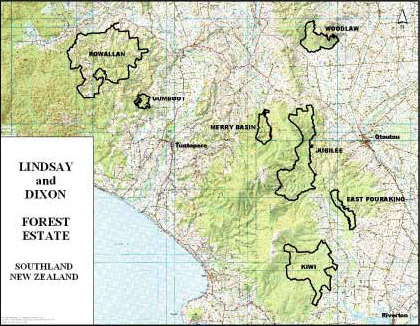
The Longwoods and Rowallan Forest Estate is managed by Lindsay & Dixon under a Forestry Cutting Right to the Waitutu Incorporation and covers about 11,902 hectares for the purpose of calculating harvest limits, comprising: Transitional crop of 5392 ha and young crop of 6510 ha. It is the largest indigenous forest in New Zealand which has a Sustainable Native Forest Management Plan approved by the Ministry for Primary Industry (MPI) under the Forests Act 1993. The estate consists of seven different blocks.

Lindsay & Dixon’s management of the Longwood & Rowallan Forest is also the only Forest Stewardship Council (FSC) certified indigenous forest in New Zealand – Compliance number RA-FM-CoC-001148.  L&D forest operations (and Chain-of-Custody) are certified by The Rainforest Alliance. The Rainforest Alliance are based in Vermont, USA and are one of 13 organisations worldwide authorised by FSC to conduct forest management and chain-of-custody certification assessments.

4. FOREST MANAGEMENT PLANNING

L&D are required by law to operate under an approved sustainable forest management plan and to have, each year, an annual logging plan approved. Under these guidelines and prescriptions, L&D are required to maintain the composition of the forest (all the species), to maintain the structure of the forest (all the different age classes of those species), to maintain all the functions of the forest (seed dispersal, regeneration, growth, decay, soil and water conservation, bird and insect habitat, etc), to control pests (both plant and animal pests) and to maintain all amenity values (water quality, visual appearance, historic and cultural values, hunting etc.).

The annual yield of the forest is limited under the terms and conditions of the SFMP to the equivalent of what grows each year (the forest’s annual increment) and extensive clearcutting is prohibited. Instead shelterwood systems using coupes, small groups and single stem felling must be used. This is done to limit the impact of harvesting, to limit forest canopy openings and to spread the cut across the forest. This is done so as to get a reasonable yield now but to also leave other trees with the conditions and space to grow ready for the next harvest cycle.

The forest consists of seven blocks and these blocks are divided into Tree Selection Areas (TSAs) of 20 to 30 hectares. Pre-harvest planning and forest yield records as well as post-harvest assessment are all based on these TSAs.

5. PRE-OPERATIONS SITE ASSESSMENT

Pre-operations site assessments are required to be done prior to harvesting operations commencing and for results to be recorded.

It is essential that at least one member of the crew walk over the TSA with the field map and GPS to get to know the ground and terrain conditions and the quality of the forest. This needs to be done so that tracks can be put in the right place to access and utilise as much of the TSA as efficiently as possible. Flagging tape or paint should be used to mark where the main access tracks are to be.

As this harvest planning progresses, the Pre-Op & Pre Harvest Planning forms are filled in. At the same time, you also need to record on the map:

*

areas which are inaccessible or not worth harvesting,

*

the location of streams and the best crossing points,

*

where streams could reasonably be classed as being 3 metres or wider,

*

the location of any historic sites,

*

logical changes to TSA boundaries and the correct path of streams where the map is wrong.

You also need to fill in the Pre-Op form to record:

*

the occurrence of old growth silver beech, rimu or other podocarps,

*

the occurrence of mistletoe or other rare, threatened or endangered species (see identification pictures below for main RTE species),

*

the presence of common animals (see list below), and,

*

any evidence of plant or animal pests (see list below).

And the Pre Harvest Planning form to record that:

*

field maps have been marked and updated where necessary,

*

relevant in-forest marking has been done, and,

*

any special trees have been marked.

GPS waypoints should be taken at places where stream crossings are planned and where historic, archaeological or cultural (Maori) sites are seen.

The completed forms, the field map, and the GPS should all be brought into the office at the earliest opportunity to enter or download the data collected and, if necessary, a revised field map produced.

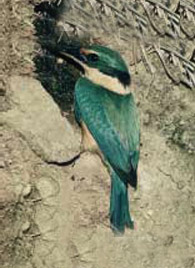
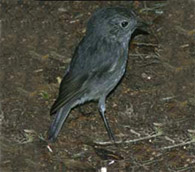
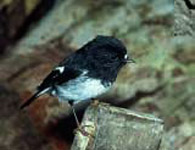
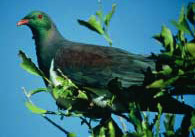
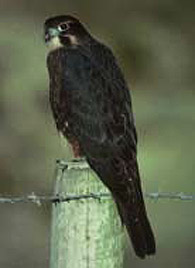
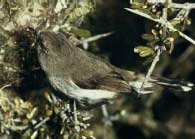
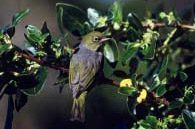
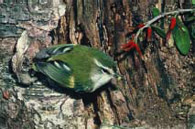
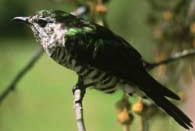
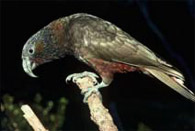
 The Pre-Operations Site Assessment requires observation of rare, threatened and endangered species as well as commonly found bird species. L&D have produced two identification guides; one for common birds and one for rare, threatened and endangered (RTE) species. A selection of photos to aid identification has been reproduced here for quick reference.

Refer to the guides themselves for the full list of species and species information.

Fantail

Chaffinch

Waxeye

Rifleman

Tui

Grey Wabler

Shining Cuckoo

Kaka

Bell Bird

Tomtit

Harrier Hawk

Robin

Kingfisher

Bush Falcon

Pigeon

Kakariki


6. DEALING WITH SPECIAL SITES

There are two broad categories of special sites. The first are sites of historic or archaeological interest or waahi tapu (sites special to Maori) which are designated by external stakeholders. The second category are those designated internally by Lindsay & Dixon.

Historic and Cultural Sites

These sites are protected by law and it is an offence to damage them without the approval of the Historic Places Trust or Tangata Whenua. It is the policy of Lindsay & Dixon Ltd that:

All archaeological and waahi tapu sites, and historic places identified within the forest estate will be:

protected and treated according to the relevant legislation and regulations, and the wishes of the Tangata Whenua;

recorded on the company’s mapping system;

systematically considered during roading, harvesting and other operational planning.

Staff and contractors will be trained in:

field recognition of archaeological sites and historical places;

procedures to be followed in the event of the accidental discovery of such sites.

Where such sites are known to be present in a proposed operations area the planner/responsible person will:

mark the location of sites on field maps supplied to harvesting crews;

mark the boundaries of the area using white or hi-viz posts or battens;

brief the relevant operations crew on the location of the site and how interference with the site is to be avoided;

check the site for any damage after operations are completed.

The L&D policy also states:

The principle in all field operations is to avoid, under all possible circumstances, disturbance to any archaeological, waahi tapu, or historic site. This is best done by careful operations & harvest planning. In the event that a previously unrecorded site, human remains, or artefacts are encountered during field operations the following will occur:

all work in the immediate vicinity will cease;

all machinery will be removed;

the area will be flagged/taped and posted as a no go area, and those working in the vicinity advised;

nothing in the discovery site (eg. remains or artefacts) will be removed;

there will be no earthworks or felling within 10 metres of the discovery site;

the operations manager will be immediately notified about the discovery.

The operations manager will notify the Historic Places Trust and seek advice from the Southland Museum/consultant archaeologist and Tangata Whenua on how to proceed. In the case of human remains, the police should be notified.

The site/ artefacts discovered will be inspected and assessed by an archaeologist and tangata whenua representative at the earliest opportunity, and if found to be a site, a plan made for its management (or legal modification).

The site will recorded on the company’s mapping system for protection during future operations planning.

Refresher training courses will be undertaken as required.

Other Special Sites

The second category of special sites includes Representative Areas, areas of High Conservation Value Forest (HCVF), areas of Rare, Threatened and Endangered species habitat (RTE) and Permanent Sample Plots.

At present, there are no Representative Areas designated in the Longwood and Rowallan forest estate. However, a block known as the West Gumboot has been designated as an L&D reserve. Similarly there are no areas specifically designated as areas of High Conservation Value Forest or RTE habitat. However, should any of these types of areas be identified, harvesting protection measures will be required.

Permanent Sample Plots (PSPs) are being established throughout the forest estate. To date (2012), forty four have been established – 3 in the Woodlaw Block, 8 in the Kiwi Block, one in the Gumboot Block, 6 Landcare Research (LR) plots in Kiwi, 6 LR plots in Woodlaw and 19 LR plots in Jubilee block.

PSPs are circular plots having a radius up to 25 metres and all trees that have been measured in the plot have been individually tagged. Trees within PSPs may be harvested but the tag on any harvested tree must be removed from the stem and hammered into the stump. The tag number must also be recorded against that stem’s diameter on your CrewCut sheet.

The centre point of PSPs will be marked on the harvesting field maps to ensure that the crew is aware that trees in the vicinity are tagged.

7. YIELD CONTROL

Yield controls are implemented to ensure the volume permitted for harvest under the approved Annual Logging Plan is compliant. The annual allowable harvest yield is based on an area control and linked to maximum limits for Standing Tree Volume. The forest is subdivided into Tree Selection Areas (TSAs) and L&D are allowed to harvest up to 25% of the area in each TSA.

8. TREE SELECTION and FELLING GUIDELINES

Before felling, identify and mark trees for permanent full life cycle retention. These are -

Exceptional or elite trees of excellent form and stature (as seed sources).

The quality of the timber in the forest will improve over time if the very best trees are left as seed sources. This is important.

Trees which contain Mistletoe (Peraxilla tetrapetala) or Peraxilla colensoi and which are rare or uncommon in the TSA.

Any trees containing mistletoe (red, white, scarlet or yellow) are required to be left standing and where practicable these trees should form part of a retention patch but in any case left as a standing tree.

Trees including dead trees and spars over 6 metres which could be nesting habitat for kaka, long-tailed and short-tailed bats, kakariki and falcon, provided those trees do not constitute a safety hazard in the immediate work environment.

Any trees which are nesting habitat for these species of fauna are required to be left standing provided they are not a safety hazard.

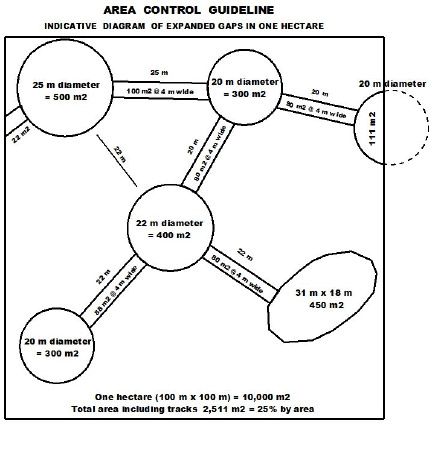
Requirements for canopy gaps.

The total expanded gap[2] area including tracking in any TSA shall not exceed 25% of the TSA area

[2]  An area measured out to the perimeter of the retained stems

Gaps shall have a minimum expanded gap area of 300 m2.

Gaps shall have a maximum expanded gap area of 5,000 m2

The distance between canopy gaps shall be no less than the average equivalent diameter of neighbouring gaps.

The shape of expanded gaps shall be as uniform and compact as possible (see diagram Appendix 1).

All species of trees selected for harvesting and which are 20 cm dbh and over within a gap shall be felled and extracted.

All trees 20 cm dbh and over that are selected for felling, whether for roading, tracking, or gap creation, must have their diameter measured at breast height and recorded.

A critical element to the L&D yield control system, for coupe areas up to 0.5ha,  is that all trees harvested or felled for whatever reason must be measured and recorded.

Measure the tree at breast height with the diameter tape supplied and record the measurement on your daily CrewCut sheet. Breast height is 1.4 metres above ground level on the uphill side of the tree. The tape must lie flat on the bark, clear of moss, debris, and swellings, and must be straight and at right angles to the line of the stem. Take time to read the tape correctly.

The measurement must be recorded in centimetres. (eg. A tree which is 1.25 metres in diameter will be recorded as 125, not 1.25m and not 1250mm). Record the diameter to the nearest centimetre. (Round 0.5 upwards).

At the top of your CrewCut sheet, you must record your name, the date (including the year), the canopy gap number and the TSA you are working in. Write the measurements neatly and in clear columns. If the tree is not a Silver beech, make sure the species code is clearly connected with its diameter. Enter the tree species ‘Ri’ (Rimu), ‘Mi’ (Miro), ‘Ma’ (Matai), ‘Ka’ (Kahikatea), ‘Km’ (Kamahi), ‘To’ (Totara).

You MUST use a new Crewcut page for a new day, a new gap or a new TSA

The crew supervisor is responsible for ensuring that all CrewCut sheets are collected and delivered to the office at least once each week. This data will be entered and analysed promptly so that the crew can get a progress report of the area and volume cut in the TSA.

All species of trees selected for harvesting, 20 cm dbh and over that are within a gap must be felled and any merchantable logs extracted.

Tracking gaps created by removing trees to access a new gap must be allocated to the new gap.

The sum of the areas of all gaps created in a TSA plus the area of tracking gaps in the TSA must not exceed 25% of the TSA area.

Trees within 20 metres of the edge of any stream 3 metres or wider must NOT be felled

In the Longwood and Rowallan Forest Estate, any stream with an average bed width of 3 metres or more automatically has a 20 metre wide Marginal Strip each side. This is required by law under the Conservation Act. No trees are to be felled inside this Marginal Strip except where essential:

·      For access to operational areas;

·      To maintain existing roading;

·      To preserve operational or public safety.

If roading, tracking or crossings associated with Marginal Strips are needed, all RMA requirements must be satisfied and the necessary Resource Consents must be obtained prior to work commencing.

The total area of expanded gaps that are within Riparian Zones of Influence (RZI) must not exceed 100m2 per 1000m2 of the RZI

Riparian Zones of Influence (RZI) are areas which:

·       Are within 5 metres of any permanently flowing stream having an average bed width of less than three metres;

·       Contain wetland or bog species;

·       Have soil conditions which are almost always saturated or are likely to be; or

·       A combination of these.

This means that unlike Marginal Strips along streams 3 metres or wider, trees can be selected and felled inside an RZI. But compared to tree selection and felling in other parts of the TSA, the canopy cannot be opened up quite so much.

Gaps shall not be placed less than 10m from the edge of any legal public road.

Directional felling techniques must be used to minimise damage to surrounding trees

The Post-operations assessment looks at how well this has been done. It looks at the direction of felling, the stump height, scarf, hinge wood, damage to neighbouring crowns, damage to upper stems & branches, damage to trunks & butts, hung-up debris and utilisation of the stem into logs. Minor damage is unavoidable and OK but it must be minimised.

At the completion of harvesting, the felling crew shall ensure that the structure and visual appearance of the stand reflects that of a well-managed forest.

9.  Pre harvest measurement and recording of STV in coupes exceeding 0.5ha up to 20ha

1.    Annual allowable Harvest – SFM Plan Clause 6.8.1

Species

Silver beech
Mountain beech
Kamahi
Rata
Rimu
Hall’s totara
Miro
Kahikatea
Matai

Total Volume

Merchantable Roundwood volume (m3)

21277
892
1680
559
142
62
53
53
9

24727

2.     The maximum area that may be harvested annually is 87.7 hectares;

3.     Measurement and recording:

The above volumes are stated in terms of standing roundwood volumes. These volumes will be derived using the tables or volume equations from the booklet “Tree Volume Equations for the Major Indigenous Species in New Zealand’.

Volumes will be based on measurements of diameter at breast height (1.4 meters) and the mean average merchantable height of each tree. The bush crew will undertake pre-harvest inventory in the form of 10 meter wide transects with their center points at 100m apart.

All live Beech trees with a 20cm DBH and over, within these transect boarders will be measured and recorded.

No harvesting is taking place until the transect data is completed.

10. The following legally binding prescriptions relate to Schedule 1 – Part 2 of the SFMP  and shall be applied to all coupes harvested exceeding 0.5 ha up to 20 ha:

1. Coupe boundaries shall be located so as to

 Provide riparian protection for permanent watercourses;

 Minimise landscape impacts;

 Retain connectivity between riparian forest, old growth forest remnants and between-coupe forest;

Avoid adverse impacts on soil stability and drainage pattern – no coupes having an area exceeding 0.5 hectares shall be harvested on slopes greater than 25 degrees, measured over any 100 meter length;

Minimise risks to stability of retained forest edges by not traversing exposed ridges;

Maintain a minimum separation between any harvested coupe having an area exceeding 0.5 hectares and a coupe proposed to be harvested in close proximity, of the width of the harvested coupe.

2. Trees shall be retained within coupe:

Healthy beech seed trees that have acquired canopy height, are of good form and are spaced across the coupe no more than 60 meters apart;

Habitat trees with high biodiversity that provide food and nesting habitat for fauna and those carrying mistletoe (Peraxilla and Alepis species);

Where practicable trees retained as habitat and seed trees along with their closest neighbours shall be retained together in patches of no less than three trees;

Trees in close proximity to habitat and seed trees which if removed could result in harvesting damage to or lead to instability of retained trees;

Groups of trees sited so as to soften the visual impacts of harvesting where the forest forms a significant part of the landscape as viewed from adjacent lands;

Advanced growth, being beech saplings and poles where their retention does not impede safe harvesting operations.

3. In siting and constructing access roads, in-forest tracking and stream crossings:

Natural drainage patterns shall be maintained;

Stream crossings shall be the minimum number necessary to provide effective forest access. In the construction of crossing stream banks shall be protected;

In the event that weather or other circumstances increases the risk of soil erosion or sedimentation, harvesting shall be suspended until the risk has been averted;

Damage to habitat trees and seed trees shall be avoided.

4. Soil scarification shall be undertaken where ground cover vegetation, especially Blechnum species is likely to impede beech regeneration. Scarification shall:

Be limited to slopes of 15 degrees or less;

Cover no more than 20% of the area of any coupe.

5. Harvesting operations shall:

Avoid mechanical damage to seed and habitat trees;

Avoid mechanical damage to residual coupe edge forest;

Ensure harvest machinery brought into the forest is cleaned prior to forest entry to remove obvious and visible clumps of soil attached;

Avoid identified areas of historic or cultural significance.

6. On completion of harvesting any coupe:

Temporary in-forest tracks shall be rehabilitated;

Temporary stream crossing shall be removed and any stream edge damage rehabilitated.

11. COUPE SEPARATION

1. The following methodology has been adopted for determining separation distances between coupes:

Measure the length of the coupe’s longest axis (in metres – being the longest measurable distance across the coupe)

Divide the coupe area (m2) by the length of the longest axis to estimate the average coupe width; and

To determine a separations distance, calculate the mean of the coupe’s longest axis and the average coupe width.

For example: a 20ha coupe with the longest axis of 550m will have a separation distance of 456.8m:

Average coupe width: 200,000m2 / 550 m = 363.6m
Separation distance: (550m + 363.6m) / 2 = 456.8m

2.     The GIS based ALP mapping will provide an accurate pre-harvest area for each mapped coupe to guide planning.

3. Following completion of each coupe’s harvest, the harvested coupe will need to be mapped. At the end of each year’s harvest, the mapped coupes can then be used to establish an operational map which shows the areas within which harvest can’t occur until regeneration requirements are met.

12. EXTRACTION GUIDELINES

Extraction operations need to avoid damage to the soil.

Extraction operations will seek to avoid unnecessary soil disturbance on forest soils by winching, minimising passes and optimising drags.

Extraction will only be carried out when track and forest soil conditions are or can be made suitable (such as with fascining).

The total length of extraction tracks in coupe areas up to 0.5ha in size (excluding single-pass snig tracks) in a TSA should not exceed 250 metres per hectare.

 The actual length of extraction track per hectare is not usually known until after operations have finished in a TSA and the tracks have been mapped with the GPS. The operations manager will advise the crew if the tracking per hectare is exceeding 250 m per hectare.

The crew supervisor may suspend log extraction operations in an area when forest soils, tracks, or skids are saturated and soil damage cannot be minimised.

Ground-based extraction operations will avoid contamination of streams.

The planning and layout of tracks will aim to minimise the number of stream crossings.

The planning and layout of tracks in a TSA needs to be done during the Pre-Op & Pre-Harvest site assessment. Walking the TSA and getting an idea of the terrain and any problem areas is essential for this aspect of harvest planning. In planning the track layout, you should also take into account any other TSAs that can only be accessed from the TSA under assessment.

Tracks crossing streams will use log bridges, culverts or other bridging structures to avoid damage to stream banks and undue water contamination.

Tracks leading down into waterways will be fascined to minimise water contamination.

As soon as practicable after leaving one TSA for another, all bridging materials will be removed from streams, all fascining and other debris pulled back from the stream, and steps will be taken to minimise water contamination from run-off (such as suitably sized and located cut-offs).

Extraction operations will avoid damage to the stand.

As far as practicable, extraction tracks will avoid sharp corners.

As far as practicable, damage to advance growth, saplings and the roots and stems of the remaining trees will be avoided during extraction. Particular care will be exercised to avoid damage to podocarp species.

Shovel logging is permitted when transferring logs across streams and in steeper areas unsuitable for dozer access.

When breaking out, the digger operator will ensure that the boom is retracted and that there is sufficient swing clearance before turning. The same shall apply in circumstances requiring shovel logging.

Sacrificial trees along extraction tracks and other trees irreparably damaged will be felled prior to moving to the next TSA.

Prior to leaving one TSA for another, all debris on tracks and skids will be tidied up.

It is important that as harvesting operations in each TSA are completed, steps are taken to reduce the impacts of the harvesting and to tidy up. Before leaving a TSA, it is essential to remove damaged stems and debris hang-ups, tidy up stream crossings and larger piles of slash and to treat any tracks which have become highly compacted, poorly drained or deeply rutted.

13. FUEL and OIL SPILLS

Fuel and oil spills in the forest may pose a danger (both toxic and fire) to people working in the forest and can impact on forest soils, groundwater, surface waterbodies, flora and fauna. Diesel, petrol and lubricating oil are used and or stored in the forest. Tanks, pipes and other containers holding these substances may be punctured, may leak, or spills may occur in the process of transferring fuel or oil in the course of operations.

One litre of oil can contaminate one million litres of water making it unfit for aquatic life or drinking. A major spill is a spill of more than 20 litres OR when 5 litres or more is spilt and could enter a waterbody. Other spills are considered minor.


An Environmental Incident Report form must be filled out for any major spill.


Measures to Avoid Fuel & Oil Spills and Pollution

Ensure all tanks, drums or other containers on-site are correctly labeled.

Monthly checks on storage tanks and containers checking for rust, leaks, and damaged or leaking hoses & fittings (Scheduled for first work day of each month).

Weekly pre-start-up checks on vehicle and machine fuel tanks, oil reservoirs, hoses and lines (Scheduled for first work day of each week).

Tanks, drums or other containers holding more than 5 litres of fuel or oil are not to be left within 10 metres of a running stream.

Fuel and oil containers and mobile fuel tanks should be positioned so as to avoid direct run-off into water-tables, waterways or riparian zones.

A suitably-sized drip tray should be positioned under filler nozzles and valves.

Care must be exercised when maneuvering vehicles or machines around or near mobile fuel tanks.

Chainsaws, chainsaw fuel and chainsaw oil containers must not be left where machine operators cannot see them.

Naked lights and hot parts of machinery must be kept at a safe distance from refueling operations.

Mobile fuel tanks must be parked in a prepared bund adjacent to but at a safe distance from the roadway (at least 3 metres) and on fairly even ground.

Fuel tank hoses need to be sufficiently long so that machinery can be parked and refueled at a safe distance.

Training is to be provided on the correct methods of refueling vehicles and machinery.

Suitable containers are to be kept on-site for waste oil, filter changes, and other contaminated waste.

At least two ‘Small Spill Kits’ and two shovels are to be kept in strategic locations (eg. one at the mobile fuel tank and one on an active machine).

Regular refreshers and training is to be provided on the correct use of the Small Spill Kit. Instructions are to be held in each vehicle and machine.

Contaminated materials and waste are to be disposed of outside the forest and at facilities and by methods approved by Environment Southland.

Procedures to Deal With Minor Spills

STOP the flow by the most immediate and practical means possible.

Remove any sources of ignition.

Contain the spill using the Small Spill Kit and or any other suitable material at hand.

Advise the Operations Manager of the incident as soon as practicable.

Complete an Environmental Incident Form within 48 hours.

Procedures to Deal With Major Spills

Follow the procedures as for Minor Spills (above) except:

Advise the Operations Manager of the incident immediately.

The Operations Manager is to report the incident to the appropriate emergency services and or Environment Southland.

The Operations Manager is to complete an Environmental Incident Form within 24 hours.


FOREST OPERATIONS BEST MANAGEMENT PRACTICE

BUSHMEN’S MANUAL

I have read the Best Management Practice Guidelines and understand the tasks and requirements.

Signed

Date