A log can be sawn (or converted) in a number of ways to make the best use of timber.
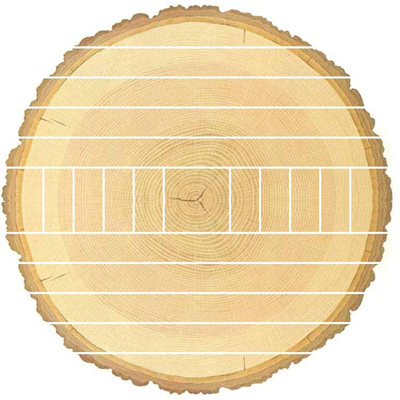
CROWN CUT
The logs are predominantly sliced from end to end, except through the unstable heart. This is the most common way that logs are milled, and produces timber that often has large crowns (or cathedrals) on the face on the milled boards.
|
Flat Sawing or Crown Cut
 |
|
QUARTER SAWN
In traditional quartersawing the planks of timber were cut like spokes of a wheel from the log, this provides a much more stable board. Modern quartersawing is a slight variation to increase the yield from the log. The ultimate goal of quartersawing is to mill timber with the grain running as close to perpendicular to the face as possible.
|
Traditional
Quartersawing |
Quartersawing
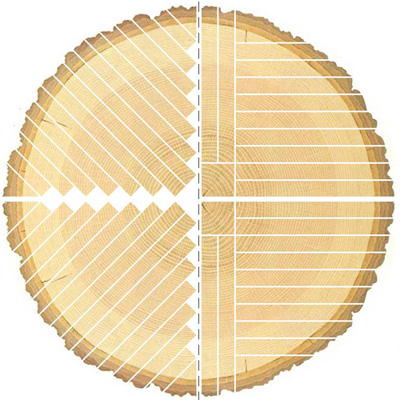 |
Modern
Quartersawing |
RIFT CUT
A cutting technique used mainly on USA Oak similar to quartersawing except the cutting angle is reduced to prevent medullary rays showing in the timber boards. Medullary rays are the ribbons of tissue that form across the growth rings and are most noticeable in Oak and Ash.
|